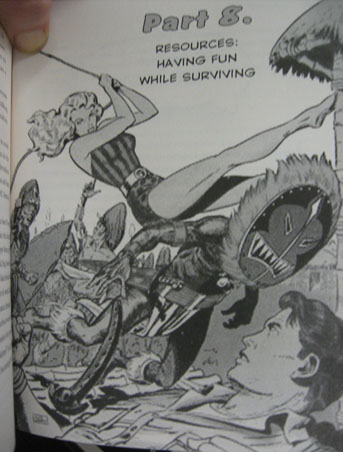
 There's been a lot of shouting and yelling about this, how it's racist, why it is beyond fucked up that anyone would have used this imagery in a book by someone who even halfway thinks of herself as progressive. It took me a while to get my chin off the desk to even read the many, many, many comments on this on many, many different blogs.
But as I was riding home on BART, I was thinking, "How would I explain why this image is so damaging?" I mean, simply saying it's racist isn't quite enough for me right now. I'm trying to think about what the image says and why that is a problem.
Well one thing it says loud and clear to me is that WOC are not the audience for this book. Because I suspect that most WOC of color seeing the dark savages would find it hard to take seriously much that the author had to say.
But it's deeper and more personal than that.
I used to joke that I wanted to be a rich, white man. I mean who wouldn't want all the privilege, all the ease that would go with living in a world that is shaped around your ideas, your desires, your values, your very language? But if I look at that joke for a minute, I have to ask, "Where did that come from?"
It came from just about everything I read, saw, or heard through most of my childhood.
When I was a kid, I was lucky enough to live in a still largely segregated town in north New Jersey (and no, I don't have the accent any more). I say I was lucky, because in those still segregated times, everyone I saw doing work, from the most menial to the most professional, was black. That meant that as well as the garbage man being black, so was my doctor, my dentist, the guy who ran the funeral parlor, and the people who drove the buses, who were the lawyers. The only exceptions were shopkeepers who tended to be Jewish or Italian and teachers, who were all white women until I went to middle school, when I had a few men (all white though).
The point is, I could see that black people did, and could do, all the important work in the world. I had a pretty big horizon for what I thought I could be as a grownup and that is, sadly, not so obviously true for a kid in a mainly black neighborhood now. Black achievement tends to be treated as exceptionalism (look at what's going on with Obama, for example) than the norm.
So if this is true, where does the rich, white man thing come from? The media.
I don't just mean the tv or newspapers. I mean the books I read, the movies I saw. In none of these places were black people the heroes/heroines. We were always the other, the savage, the native, the ignorant, the criminal, the promiscuous, the poor, the addicted, the stupid, the servants.
Why should this matter when there were all these great role models walking around in front of me? (My own family included.) It matters because regardless of what I saw around me, the media, in all its manifestations, is what teaches us to dream. And if I wanted to dream though the books, through the movies, through the tv, I had to do some substitution. I had to take on the face of white, mainly men, to be the one who did things.
You don't think this matters? You don't think it does something to you to have to translate yourself in order to be the paladin, the knight, the king? Well, given how I felt when I started to learn about black people who were heroic - Truth, L'Ouverture, the Maroons, - I'd have to say you were wrong.
One of the most touching poems in Shange's For Colored Girls, is the piece on Toussaint L'Ouverture, where a little girl projects herself into this heroic form. It's a form that fits (well aside from the whole time and gender thing), but at least it's not friggin' Robin Hood. It's not an ocean and a race and a history away.
So to see these pictures, where again, after all this time we're reduced to caricature as the evil that has to be overcome is just toxic. And again we are not the agents, we are not the heroes. Hell, we don't even have faces.


