I have been meaning to write something about the primary for a while, but I am just too tired of it all. I am tired of what is reveals about the underside, or maybe not so underside of this country's psyche.
A couple of weeks ago I commented on some blog or other how Clinton and Obama seem to be taking on these mythic qualities. The candidates have just about disappeared as individuals, become these avatars of gender and race.
This pretty much guarantees that lots of people have pretty much stopped thinking. This is true of both Clinton and Obama camps. I think I had been bothered a little more by the Obama supporters than the Clinton ones for a couple of reasons.
First, the misogyny has really been making me crazy. A couple of years ago when someone or other raised the possibility of HRC running for president, I thought "Oh fuck, no!" This was because I knew that the right wing that had been on both Clinton's case while they were in the Whitehouse, would be out in force against her. And I've been right. But all over the liberal fauxgressive blogosphere are the bitch jokes and the complaints about her clothes, her voice, her demeanor.
But now Clinton is wearing me out, too. The appeal to "hard-working Americans, white Americans" jeez. I hope that it was exhaustion taking her there because I don't really believe that she's a holds some weird racist notions about who in this country is hard working and who is not.
There's a post over on one of the big progressive blogs, Hullabaloo, that suggests that Obama is
attempting to build a different Democratic Party from under the DLC. In some ways that would be a good thing.
If.
If it were a progressive move. But there's really not much in Obama's policies or public speaking that makes me think he's anything of a progressive. His stand on abortion is pro-choice, but framed in language that bows to the anti-choice side. (i.e. that an abortions is something that a woman decides after consulting with her pastor? oh really?) His excuses for the McClurkin mess back in the fall, i.e. that he believes in communicating with both sides, troubles me because I believe he has little to offer the lgbt community but patronizing rhetoric. Finally there's his tossing Reverend Wright under the bus. Because Wright - with all his cracked notions about HIV and right and left sides of the brain - is a real working progressive, with an acute critique of US social, political, economic, and foreign policy. This is what Obama is stepping away from, as he assuages the nerves of white people who are ignorant about African American experience in this country and who want to stay that way.
And to tell the truth, I cannot stand white Obama supporters who, for some reason, think that we will have entered the New Jerusalem in this country if we just elect a black guy.
As though this one act will wipe out all the bad stuff, as though we can finally forget about slavery, about Reconstruction, about Jim Crow, about the Tulsa Riots, about little girls getting bombed, about segregation north, south, east, and west, about the way that poverty in this country is still color-coded, about driving while black, about all the tiny, tiny insults that pile up day after day, until . . . . Well, I'm really not shocked that many of the crazy people wailing on the street corners in San Francisco are black. We should all scream.
But, some think that having those nice black people in the Whitehouse is really all we need.
Sunday, May 04, 2008


Friday, April 25, 2008
looking at pictures
There's been another train wreck in the feminist blogosphere. Ico and a pal went and took pictures of the interior of Amanda Marcotte's book and it ain't pretty.
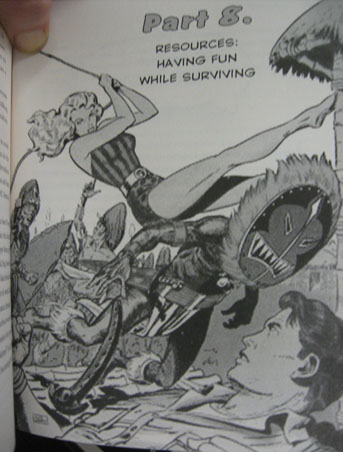 There's been a lot of shouting and yelling about this, how it's racist, why it is beyond fucked up that anyone would have used this imagery in a book by someone who even halfway thinks of herself as progressive. It took me a while to get my chin off the desk to even read the many, many, many comments on this on many, many different blogs.
But as I was riding home on BART, I was thinking, "How would I explain why this image is so damaging?" I mean, simply saying it's racist isn't quite enough for me right now. I'm trying to think about what the image says and why that is a problem.
Well one thing it says loud and clear to me is that WOC are not the audience for this book. Because I suspect that most WOC of color seeing the dark savages would find it hard to take seriously much that the author had to say.
But it's deeper and more personal than that.
I used to joke that I wanted to be a rich, white man. I mean who wouldn't want all the privilege, all the ease that would go with living in a world that is shaped around your ideas, your desires, your values, your very language? But if I look at that joke for a minute, I have to ask, "Where did that come from?"
It came from just about everything I read, saw, or heard through most of my childhood.
When I was a kid, I was lucky enough to live in a still largely segregated town in north New Jersey (and no, I don't have the accent any more). I say I was lucky, because in those still segregated times, everyone I saw doing work, from the most menial to the most professional, was black. That meant that as well as the garbage man being black, so was my doctor, my dentist, the guy who ran the funeral parlor, and the people who drove the buses, who were the lawyers. The only exceptions were shopkeepers who tended to be Jewish or Italian and teachers, who were all white women until I went to middle school, when I had a few men (all white though).
The point is, I could see that black people did, and could do, all the important work in the world. I had a pretty big horizon for what I thought I could be as a grownup and that is, sadly, not so obviously true for a kid in a mainly black neighborhood now. Black achievement tends to be treated as exceptionalism (look at what's going on with Obama, for example) than the norm.
So if this is true, where does the rich, white man thing come from? The media.
I don't just mean the tv or newspapers. I mean the books I read, the movies I saw. In none of these places were black people the heroes/heroines. We were always the other, the savage, the native, the ignorant, the criminal, the promiscuous, the poor, the addicted, the stupid, the servants.
Why should this matter when there were all these great role models walking around in front of me? (My own family included.) It matters because regardless of what I saw around me, the media, in all its manifestations, is what teaches us to dream. And if I wanted to dream though the books, through the movies, through the tv, I had to do some substitution. I had to take on the face of white, mainly men, to be the one who did things.
You don't think this matters? You don't think it does something to you to have to translate yourself in order to be the paladin, the knight, the king? Well, given how I felt when I started to learn about black people who were heroic - Truth, L'Ouverture, the Maroons, - I'd have to say you were wrong.
One of the most touching poems in Shange's For Colored Girls, is the piece on Toussaint L'Ouverture, where a little girl projects herself into this heroic form. It's a form that fits (well aside from the whole time and gender thing), but at least it's not friggin' Robin Hood. It's not an ocean and a race and a history away.
So to see these pictures, where again, after all this time we're reduced to caricature as the evil that has to be overcome is just toxic. And again we are not the agents, we are not the heroes. Hell, we don't even have faces.

There's been a lot of shouting and yelling about this, how it's racist, why it is beyond fucked up that anyone would have used this imagery in a book by someone who even halfway thinks of herself as progressive. It took me a while to get my chin off the desk to even read the many, many, many comments on this on many, many different blogs.But as I was riding home on BART, I was thinking, "How would I explain why this image is so damaging?" I mean, simply saying it's racist isn't quite enough for me right now. I'm trying to think about what the image says and why that is a problem.
Well one thing it says loud and clear to me is that WOC are not the audience for this book. Because I suspect that most WOC of color seeing the dark savages would find it hard to take seriously much that the author had to say.
But it's deeper and more personal than that.
I used to joke that I wanted to be a rich, white man. I mean who wouldn't want all the privilege, all the ease that would go with living in a world that is shaped around your ideas, your desires, your values, your very language? But if I look at that joke for a minute, I have to ask, "Where did that come from?"
It came from just about everything I read, saw, or heard through most of my childhood.
When I was a kid, I was lucky enough to live in a still largely segregated town in north New Jersey (and no, I don't have the accent any more). I say I was lucky, because in those still segregated times, everyone I saw doing work, from the most menial to the most professional, was black. That meant that as well as the garbage man being black, so was my doctor, my dentist, the guy who ran the funeral parlor, and the people who drove the buses, who were the lawyers. The only exceptions were shopkeepers who tended to be Jewish or Italian and teachers, who were all white women until I went to middle school, when I had a few men (all white though).
The point is, I could see that black people did, and could do, all the important work in the world. I had a pretty big horizon for what I thought I could be as a grownup and that is, sadly, not so obviously true for a kid in a mainly black neighborhood now. Black achievement tends to be treated as exceptionalism (look at what's going on with Obama, for example) than the norm.
So if this is true, where does the rich, white man thing come from? The media.
I don't just mean the tv or newspapers. I mean the books I read, the movies I saw. In none of these places were black people the heroes/heroines. We were always the other, the savage, the native, the ignorant, the criminal, the promiscuous, the poor, the addicted, the stupid, the servants.
Why should this matter when there were all these great role models walking around in front of me? (My own family included.) It matters because regardless of what I saw around me, the media, in all its manifestations, is what teaches us to dream. And if I wanted to dream though the books, through the movies, through the tv, I had to do some substitution. I had to take on the face of white, mainly men, to be the one who did things.
You don't think this matters? You don't think it does something to you to have to translate yourself in order to be the paladin, the knight, the king? Well, given how I felt when I started to learn about black people who were heroic - Truth, L'Ouverture, the Maroons, - I'd have to say you were wrong.
One of the most touching poems in Shange's For Colored Girls, is the piece on Toussaint L'Ouverture, where a little girl projects herself into this heroic form. It's a form that fits (well aside from the whole time and gender thing), but at least it's not friggin' Robin Hood. It's not an ocean and a race and a history away.
So to see these pictures, where again, after all this time we're reduced to caricature as the evil that has to be overcome is just toxic. And again we are not the agents, we are not the heroes. Hell, we don't even have faces.
Thursday, April 24, 2008
this is a test
They say you can put polls on these pages now. Over there to your right is a poll.
So, take it already.
So, take it already.
Sunday, April 13, 2008
living in small places
A couple of weeks ago I was driving home south along Sixth Street in Berkeley. Parked on the left hand side of the street was a large van, the size of a UPS delivery van. I couldn't see into the back of the truck because there was curtain or large piece of fabric hanging behind the driver's seat. As I drove past, it reminded me of a van much like it that a friend of mine name Lamar lived in years ago, up in Seattle.
There was room in it for a narrow bed, a chair, a workbench, a stereo (well a boombox), and a cooler. There might have been a hot plate, but probably not. I thought it was wonderful, to have your life in a tiny space that you could take around with you. When I was about twenty, I lived in a tepee for a summer. Everything I owned could be put in a backpack (and I did when I finally went out to California).
There was something lovely and light about having so few possessions and needing so little space to live in.
Now I share a house with my partner and I'm in the process of unpacking 30+ boxes that have been in storage for a couple of years. The contents are mainly books and the unpacking gets slowed down because I find myself going, "I forgot I had that!" then sitting down and reading for a half hour. I have a lot more stuff than I had when I did when I was twenty. My life is a lot more complex and undeniably richer, though moving probably means a real moving van by this point.
I was thinking about this during the flamefest around an appropriation of a WOC's work by a prominent (whatever that means online) white feminist blogger. Aside from the sadly predictable, shamefully feeble defense put on by blogger X and her posse, the thing that struck me was what a tiny space she lives in.
I don't know what her physical space is like, but her mental space is incredibly impoverished. Her response is only about her reputation, her career, her feelings. There's not a whisper of awareness that anyone else in the world exists. This sort of solipsism is like living out of a backpack - limited perspectives, limited resources, limited options. It might feel unencumbered and it's easy to move around, but how poor, how thin, how shabby.
The van Lamar lived in wasn't shabby, and she moved on to get a house to contain all the art she does and all the people she knows. I moved out of the tepee to acquire an unnerving number of books, but I think X is never going to move. I think she's going to cover the windows of the truck with aluminum foil and park it in some friend's backyard and there she'll stay.
There was room in it for a narrow bed, a chair, a workbench, a stereo (well a boombox), and a cooler. There might have been a hot plate, but probably not. I thought it was wonderful, to have your life in a tiny space that you could take around with you. When I was about twenty, I lived in a tepee for a summer. Everything I owned could be put in a backpack (and I did when I finally went out to California).
There was something lovely and light about having so few possessions and needing so little space to live in.
Now I share a house with my partner and I'm in the process of unpacking 30+ boxes that have been in storage for a couple of years. The contents are mainly books and the unpacking gets slowed down because I find myself going, "I forgot I had that!" then sitting down and reading for a half hour. I have a lot more stuff than I had when I did when I was twenty. My life is a lot more complex and undeniably richer, though moving probably means a real moving van by this point.
I was thinking about this during the flamefest around an appropriation of a WOC's work by a prominent (whatever that means online) white feminist blogger. Aside from the sadly predictable, shamefully feeble defense put on by blogger X and her posse, the thing that struck me was what a tiny space she lives in.
I don't know what her physical space is like, but her mental space is incredibly impoverished. Her response is only about her reputation, her career, her feelings. There's not a whisper of awareness that anyone else in the world exists. This sort of solipsism is like living out of a backpack - limited perspectives, limited resources, limited options. It might feel unencumbered and it's easy to move around, but how poor, how thin, how shabby.
The van Lamar lived in wasn't shabby, and she moved on to get a house to contain all the art she does and all the people she knows. I moved out of the tepee to acquire an unnerving number of books, but I think X is never going to move. I think she's going to cover the windows of the truck with aluminum foil and park it in some friend's backyard and there she'll stay.
Friday, March 07, 2008
who knew?
|
|

Something a little more serious later today.
Wednesday, February 06, 2008
Costa Rica

We went to Costa Rica a few weeks ago.
It was the first time that I'd ever been out of the country. Or at least out enough to need a passport to leave and come back.
Going to Costa Rica was an afterthought. Staying for a whole week was a fall back option.
It was amazing.
Neither of us has much Spanish, so we asked the managers of the hotel where we stayed for a bilingual driver to take us to Volcano Poas and the Butterfly Waterfall. These are both pretty standard tourist stops for the Central Highlands. We expected to get a driver who could understand us, would take us to the sights, wait for us and take us back.
Who we got was Wilson Rojas, who had decided that he was our guide to his country and took us places we would never have thought to have gone by ourselves.
Costa Rica is an astonishing country. Ticans are truly nice people with time for the most ignorant of Northern tourists. The landscape is wildly varied and beautiful, We had the best time and plan to go back again, when we can afford it.
But
Costa Rica is a poor country. In the Central Highlands, where we stayed, people live in shacks made of wood scraps and metal sheets right up against the side of the road. Some of the shacks on the road up to Sarchi (where ornamental ox carts are made) are probably less than 225 sq. ft. We saw clothes drying on the roofs of house that had nowhere to put a clothes line. People walk everywhere and, according to Wilson, there's pretty good bus service. There aren't many cars, compared to the Bay Area for example, and most of the ones I saw on the road are older models, Korean or Japanese.
In Costa Rica, we were the rich. We woke up every day to beautiful views at the edge of a canyon overlooking the Rio Grande. We walked through carefully tended gardens, around koi ponds to have breakfast in a gazebo suspended high over the river below. Men in white shirts and black pants brought us fresh juice and hot breakfasts, if we wanted something other than granola and fresh fruit. These same men brought us dinner at night.
It raised a discomfort that I still feel more than a month later. I kept saying, "Thank you" or "Muchas gracias" after every service and received a quiet "Mucho gusto" from each waiter. But that acknowledgment, doesn't mask the fact that he's waiting on me, that he can pretty much only make a living by waiting on me and people like me, and that he's probably fortunate to work where the owners seem conscientious about their workers.
It's easy to ignore the fact Costa Rica is hostage to our policies. All over the highlands I saw graffiti about the TLC. When I asked Wilson about this, he explained that this was about the free trade zone (NAFTA to us) and that it was a good thing for the country. And most of the graffiti I saw near Alajuela was pro TLC. After a few days of riding around together, he admitted that he'd voted against it. The further north we went, the more anti-TLC graffiti we saw, especially in San Ramon, which seemed a more industrial town.
And it's easy to miss the fact that Costa Rica has its own internal problems. We had stopped at a coffee plantation somewhere south of Fraijanes. I can't remember the name of the plantation, but it sells 80% of it's produce to Starbucks. We walked down and looked at the plants and Wilson pointed out the cabins where the pickers lived. These pickers are migrant workers from Nicaragua. He said that Ticans don't want to pick coffee, that it's hard, poorly paid work, that it's dangerous on the steep hills, with the snakes in the groves. It's a depressingly familiar argument. When we had walked back to the van to head back to the hotel, Wilson asked the boy whose picture is at the top of this post if we could take his picture. He was carrying a basket when we came up to him, but put it down after Wilson told him that we wanted to take a picture of him because he was, "muy guapo."
He is of course. But he looks way older than then ten years old that I estimate he was. He makes maybe 1,483 colones (three dollars) a day for his family by picking coffee beans. And from what we heard, they depend on the help too. This isn't an after school job. The Nicaraguans are the poorest in a poor country. They're many of the people who are walking the narrow, twisting roads.
We saw a woman who had been hit by a car as she was walking home from work. People crouched around her, looking panicked as they waited for the ambulance to show up. (It came soon after and the woman was ok. No one knew anything about the driver.) They were, according to Wilson, probably Nicaraguan, probably coffee pickers.
So even though most of my memories of Costa Rica are of beautiful birds, days with four or five different types of weather in them, cloud forests, ceviche in a no-tourist-in-sight restaurant, passiflora, pejibaye, and waterfalls dropping into the deepest green forests, I am more than a little haunted by a serious, slightly worried smile.
Sunday, January 13, 2008
burning up the thread, online political discourse
Recently I was participating in a thread on ally-work on a blog I like and respect. The discussion grew out of the incredibly poor interactions that followed the call for submissions for a new book by Seal Press. I'm not making any links to the firefight. Anyone who stumbles across this site and wants to find out about it can go look it up themselves. What I want to think through here is how online discourse helps and hinders political work.
To be honest I haven't been involved in the down and dirty business of political work, the attempts at coalition building, the interminable meetings, the small but real accomplishments, for years. My work like that pretty much stopped once I went off to graduate school in 1989. And even though I work for a lgbt advocacy organization these days, I don't think of myself as a political activist any more. I'm more of a problem solver and analyst, occasional writer.
Before that though, I lived in Seattle and was an active member of the lgbt (mainly lesbian) community. I served on non-profit boards. I worked with the local black nationalist caucus as a tutor and helped to produce a couple of radio shows. I was a member of Tilth, involved with the natural foods movement in the Pacific Northwest largely because of my job in a owner-operated natural foods warehouse. That latter also meant that for years I spent every Thursday afternoon in management meetings with the whole staff. That could mean more than 15 women. That meant really bad and really good meetings and I learned a lot from doing all of this.
So how does this relate to the recent online incidents?
The same dynamics are in play. The same engaged and creative energies. The same self-regarding, destructive bullshit. How does this all change when we're individuals typing away at keyboards scattered across the globe rather than staring at each other across a too-small or too-large room?
One important factor is the nature of web-reading. Most people read blogs for entertaining content. I know, I know. There are a number of studies that show that many people, especially those under forty or so, are getting their news from the internet. But tell me that they don't read it as entertaining information. There are lots of people proud to get their news from John Stewart. He's a funny, clever man, but he's no journalist and would be the first to tell you so. People reading different websites, especially blogs, are looking for information, but they are also looking for something to distract them at work, during their commute, at home. That has meant, and continues to mean, that performance is more highly regarded than content.
Also, in the interactive comments of blog threads, participants are also rewarded for their performances. This is why trolls cause blogs to rack up huge comment counts, even though everyone (except the terminally naive) knows that trolls are not about to change their minds about anything. But a snappy, cogent, or brutal put-down of a troll will get a writer a whole chorus of virtual, verbal pats on the back.
And those pats feel good.
I've gotten the same nice glow when I've posted a comment and someone noticed it. It's human. We want to be noticed. We want to be liked. And one of the easiest ways to do this online is to savage someone. Another way to be noticed is to write a post full of emotion. It's as though a nakedly emotional post will get adherents because the emotional current makes the content feel "realer" to a reader.
Put three posts side by side. Make A a calmly argued, logically structured, even beautiful essay. Make B a full on emotional diatribe, making sure to keep it somewhat coherent. It can't read as flat-out insane. Make C a sardonic, clever piece of wordplay that manages to make any opponents look like fools. How will they rank? Well based on my experience C will get the most attention, B next and A will come in a sorry last.
Maybe I'm cynical, but I don't think I'm wrong.
What does this have to do with online political work? Well, take an audience that's predisposed to regard the medium as entertainment and primed with the dynamics I've described and it's a recipe for disaster. The behaviors that lead to the worst real-world meetings are the following:
But thinking through your own reactions takes training and it takes time. And time is at a premium in a online discussion. This is another factor that can make online collaborative work so difficult, if not impossible. In the real world, it takes ages to work out a coalition, especially if you're bringing together people who haven't worked together before, who have reason to distrust each other. But in an online discussion, you have to hit it quick or the moment will have passed you by. That wonderful thing you were going to say loses its context and relevance. It will disappear without an answer, without an echo, without a sound. So there's every incentive to type fast, to type first thing that comes to mind, to type the words that will have the greatest impact.
You could type something perfect, but the odds are against it.
You'll probably type what you feel not what you could have thought if you had a day or so. You'll probably type out of your reactions rather than your principles. And you'll type for your audience, wanting to please, instruct, anger, enlighten, and entertain.
You're going to give a performance.
But a lot of political activism is not performance (though you'll hardly know it in an election year). Coalitions depend on discussions to make decisions that everyone can live with (and this doesn't have to mean concessions). It's carrying out the tasks that have to get done. It's doing all of this because something real is at stake.
Online, the stakes are not so clear. The stakeholders are a shifting, amorphous crowd of mainly strangers. Maybe we do such a poor job of this because, really, there's nothing to lose.
To be honest I haven't been involved in the down and dirty business of political work, the attempts at coalition building, the interminable meetings, the small but real accomplishments, for years. My work like that pretty much stopped once I went off to graduate school in 1989. And even though I work for a lgbt advocacy organization these days, I don't think of myself as a political activist any more. I'm more of a problem solver and analyst, occasional writer.
Before that though, I lived in Seattle and was an active member of the lgbt (mainly lesbian) community. I served on non-profit boards. I worked with the local black nationalist caucus as a tutor and helped to produce a couple of radio shows. I was a member of Tilth, involved with the natural foods movement in the Pacific Northwest largely because of my job in a owner-operated natural foods warehouse. That latter also meant that for years I spent every Thursday afternoon in management meetings with the whole staff. That could mean more than 15 women. That meant really bad and really good meetings and I learned a lot from doing all of this.
So how does this relate to the recent online incidents?
The same dynamics are in play. The same engaged and creative energies. The same self-regarding, destructive bullshit. How does this all change when we're individuals typing away at keyboards scattered across the globe rather than staring at each other across a too-small or too-large room?
One important factor is the nature of web-reading. Most people read blogs for entertaining content. I know, I know. There are a number of studies that show that many people, especially those under forty or so, are getting their news from the internet. But tell me that they don't read it as entertaining information. There are lots of people proud to get their news from John Stewart. He's a funny, clever man, but he's no journalist and would be the first to tell you so. People reading different websites, especially blogs, are looking for information, but they are also looking for something to distract them at work, during their commute, at home. That has meant, and continues to mean, that performance is more highly regarded than content.
Also, in the interactive comments of blog threads, participants are also rewarded for their performances. This is why trolls cause blogs to rack up huge comment counts, even though everyone (except the terminally naive) knows that trolls are not about to change their minds about anything. But a snappy, cogent, or brutal put-down of a troll will get a writer a whole chorus of virtual, verbal pats on the back.
And those pats feel good.
I've gotten the same nice glow when I've posted a comment and someone noticed it. It's human. We want to be noticed. We want to be liked. And one of the easiest ways to do this online is to savage someone. Another way to be noticed is to write a post full of emotion. It's as though a nakedly emotional post will get adherents because the emotional current makes the content feel "realer" to a reader.
Put three posts side by side. Make A a calmly argued, logically structured, even beautiful essay. Make B a full on emotional diatribe, making sure to keep it somewhat coherent. It can't read as flat-out insane. Make C a sardonic, clever piece of wordplay that manages to make any opponents look like fools. How will they rank? Well based on my experience C will get the most attention, B next and A will come in a sorry last.
Maybe I'm cynical, but I don't think I'm wrong.
What does this have to do with online political work? Well, take an audience that's predisposed to regard the medium as entertainment and primed with the dynamics I've described and it's a recipe for disaster. The behaviors that lead to the worst real-world meetings are the following:
- Rigidity
- Insecurity
- Loud, Obstinate Ignorance
- Concealed Motives
- Poor Faith Arguments
- Unexamined Motives
But thinking through your own reactions takes training and it takes time. And time is at a premium in a online discussion. This is another factor that can make online collaborative work so difficult, if not impossible. In the real world, it takes ages to work out a coalition, especially if you're bringing together people who haven't worked together before, who have reason to distrust each other. But in an online discussion, you have to hit it quick or the moment will have passed you by. That wonderful thing you were going to say loses its context and relevance. It will disappear without an answer, without an echo, without a sound. So there's every incentive to type fast, to type first thing that comes to mind, to type the words that will have the greatest impact.
You could type something perfect, but the odds are against it.
You'll probably type what you feel not what you could have thought if you had a day or so. You'll probably type out of your reactions rather than your principles. And you'll type for your audience, wanting to please, instruct, anger, enlighten, and entertain.
You're going to give a performance.
But a lot of political activism is not performance (though you'll hardly know it in an election year). Coalitions depend on discussions to make decisions that everyone can live with (and this doesn't have to mean concessions). It's carrying out the tasks that have to get done. It's doing all of this because something real is at stake.
Online, the stakes are not so clear. The stakeholders are a shifting, amorphous crowd of mainly strangers. Maybe we do such a poor job of this because, really, there's nothing to lose.
Friday, December 21, 2007
the place for thinking
I've been a rotten blogger for months now.
I kept meaning to post something, but somehow never got around to it.
I was going to write something about my great-aunt (who's doing fine* now and my sister is living with her, an arrangement that seems to be working out for both of them).
I was going to write something about commuting, now that I take BART to work every morning.
I was going to write something about observing more black women with straightened and colored hair recently than I've seen (or noticed) for years.
But the thing that got me to open up the old Blogger account is Errol Morris' set of essays on Fenton's two photos of an empty road in the Crimea. He starts out trying to establish in what order a pair of photographs were taken and goes on into thoughts about war, about intention, about how you figure things out. Nikita Khrushchev even shows up (so to speak) in the second section. It's fascinating reading and I've taken to reading some of his other essays in his Zoom columns on the NYT website. It's a lot of food for thought and so it's getting late and even though I'm getting over an awful cold and should be in bed, I keep reading.
Because it's fun to think about this stuff.
I am rediscovering the pleasure of thinking about things that have no immediate use. I have always loved this. But I had sort of stopped for quite a while. Somehow having a job that, though it uses a lot of mental energy sometimes, is not overly intellectual has freed me up for the not-so-simple pleasures of thinking.
You would have thought being in academia would have done that. I think it does it for a lot of people. But it didn't do it for me. In part, I think it was because that was what I expected university life to be like (too many movies, probably). But I think it's also because this thinking thing has always been about fun for me and once something gets past the fun part to the work part, I don't so so well.
I'd say that mentally, I'm a sprinter rather than a marathoner. I have to trick myself to do things that take longer than 20 minutes** to complete. I have a lot of tricks now, switching between tasks, promising myself some sort of treat if I stick to it for another ten minutes, and so on to get things done. Often enough the tricks work and I end up spending an extended period of time working without feeling bored or trapped, but it doesn't come naturally to me.
So for me thinking is, at it's best, a ludic activity.
Which also might explain why I haven't blogged in months. It's felt too much like work and I hate working. But maybe it's going to feel like play again.
* well, as fine as you can be at 93+ years old.
** ok, I exaggerate, longer than a half hour.
I kept meaning to post something, but somehow never got around to it.
I was going to write something about my great-aunt (who's doing fine* now and my sister is living with her, an arrangement that seems to be working out for both of them).
I was going to write something about commuting, now that I take BART to work every morning.
I was going to write something about observing more black women with straightened and colored hair recently than I've seen (or noticed) for years.
But the thing that got me to open up the old Blogger account is Errol Morris' set of essays on Fenton's two photos of an empty road in the Crimea. He starts out trying to establish in what order a pair of photographs were taken and goes on into thoughts about war, about intention, about how you figure things out. Nikita Khrushchev even shows up (so to speak) in the second section. It's fascinating reading and I've taken to reading some of his other essays in his Zoom columns on the NYT website. It's a lot of food for thought and so it's getting late and even though I'm getting over an awful cold and should be in bed, I keep reading.
Because it's fun to think about this stuff.
I am rediscovering the pleasure of thinking about things that have no immediate use. I have always loved this. But I had sort of stopped for quite a while. Somehow having a job that, though it uses a lot of mental energy sometimes, is not overly intellectual has freed me up for the not-so-simple pleasures of thinking.
You would have thought being in academia would have done that. I think it does it for a lot of people. But it didn't do it for me. In part, I think it was because that was what I expected university life to be like (too many movies, probably). But I think it's also because this thinking thing has always been about fun for me and once something gets past the fun part to the work part, I don't so so well.
I'd say that mentally, I'm a sprinter rather than a marathoner. I have to trick myself to do things that take longer than 20 minutes** to complete. I have a lot of tricks now, switching between tasks, promising myself some sort of treat if I stick to it for another ten minutes, and so on to get things done. Often enough the tricks work and I end up spending an extended period of time working without feeling bored or trapped, but it doesn't come naturally to me.
So for me thinking is, at it's best, a ludic activity.
Which also might explain why I haven't blogged in months. It's felt too much like work and I hate working. But maybe it's going to feel like play again.
* well, as fine as you can be at 93+ years old.
** ok, I exaggerate, longer than a half hour.
Thursday, September 06, 2007
thinking in black and white
I don't usually think about writing about race. For one thing, I wouldn't know where to start. Part of that is because I've been a progressive (and an academic manqué) and therefore my impulse is to place race among the array of power dynamics facing all of us. Throw in the multiplicity of race prejudice and I can't really think of anything to say.
But sometimes, things break through. The second thing was this post from Lower Manhattanite. I'd heard, read about the Jena 6 awhile back, but I hadn't heard about the sentencing. The chilling thing about LM's story is that 14 years ago is nothing, nothing at all.
The first thing though came completely out of the blue. I pay about as much attention to professional tennis as I do to professional golf, which is a little more than absolutely nothing. I'm guessing it's a big tournament and a little Googling uncovers that it's the U.S. Open. I was riding the BART into work a couple of days ago, something I'm still getting a kick out of, when I glanced over some one's shoulder and saw the sports page. On the page a headline that read something like "Henin beats Serena" something like that, I may have the verb wrong. I probably do. But the thing that has been bugging me for days is that Henin and Serena. The white player gets her last name, as is usual for athletes, unless they have some nickname thing going on. Serena, hell, they can just call her by her first name. There's this nearly ubiquitous use of women's names rather than their surnames in this culture that's bad enough. But it's the casualness of this racism, this seemingly completely unconscious condescension that floors me.
And you can bet that the writer would completely deny any racist intent if I called him on it too.
But sometimes, things break through. The second thing was this post from Lower Manhattanite. I'd heard, read about the Jena 6 awhile back, but I hadn't heard about the sentencing. The chilling thing about LM's story is that 14 years ago is nothing, nothing at all.
The first thing though came completely out of the blue. I pay about as much attention to professional tennis as I do to professional golf, which is a little more than absolutely nothing. I'm guessing it's a big tournament and a little Googling uncovers that it's the U.S. Open. I was riding the BART into work a couple of days ago, something I'm still getting a kick out of, when I glanced over some one's shoulder and saw the sports page. On the page a headline that read something like "Henin beats Serena" something like that, I may have the verb wrong. I probably do. But the thing that has been bugging me for days is that Henin and Serena. The white player gets her last name, as is usual for athletes, unless they have some nickname thing going on. Serena, hell, they can just call her by her first name. There's this nearly ubiquitous use of women's names rather than their surnames in this culture that's bad enough. But it's the casualness of this racism, this seemingly completely unconscious condescension that floors me.
And you can bet that the writer would completely deny any racist intent if I called him on it too.
Thursday, July 12, 2007
again and again

Yesterday I was watching Seven Samurai. I don't remember why I got it from Netflix. I've probably watched it about six times by now. It just keeps getting better and better. Once I'd finished watching it, I started to re-read "The Last Samurai" by Helen DeWitt. It's a wonderful book and reading it made me think about two things, the pleasures of rereading and why some books are so satisfying and others aren't.
For the latter, I'm not going to make some argument about high art. This summer I"ve been compulsively re-reading Terry Pratchett's Discworld series and Charles DeLint's Newford novels. You could probably make the argument that Pratchett's a genius, but I don't think the same could be said for DeLint. But re-reading both of them gives me a lot of pleasure. Part of the fun is they're both good at constructing plots. But once you get past the what-is-going-to-happen-next stage of reading, what is there?
In their cases and in DeWitt's too, it's making a world that's so fully realized that a reader enters it like Alice (or Death) going through a mirror. It's not a matter of spelling everything out. That makes for tedious reading and gets in the way of the effect that I'm trying to describe. Theodore Sturgeon once wrote something about description to the effect that a writer needed to imagine every detail in a room, everything, but then she needed to leave out everything except what the character (or pov) would notice. Who knows how many writers can actually do that? But the point, I guess, is that the world (country, neighborhood, street, house, or room) that's written so so well imagined, even if not explicitly, that it's all there, ready. A reader is held in the imaginative world of the book.
When that doesn't happen, there has to be high style, great plotting, or something to make a book worth reading. Recently a friend recommended The Shadow of the Wind. The cover blurbs compared it to Eco, Borges, Garcia-Marquez. Do reviewers just pull this shit out of the air? Ok, there was a library in it and a mysterious character is a writer, but there the resemblance stops. A worse conceived book I can't imagine reading. I started to make notes on all the lapses of logic, failures of character development, and just plain stupid writing, but had to give up after half a chapter. It's the sort of thing that can embitter a reader.
But the worst thing about it (aside from being pretty tone-deaf though that could have been a translation issue) was that it was supposed to take place in Barcelona and I could never see the city. It's as though all the action took place in feebly illuminated corners of rooms or dark streets, surrounded by an impenetrable fog. Characters pop up in one spot, then merged into the fog to pop up at another. This is pretty bizarre when you remember that this is Gaudi's city. It's famous for it's beauty. And according to Google, it doesn't rain all that much there either. If a writer can't make a living place palpable, then reading them is going to be a chore.
This summer, no more chores.
Monday, May 14, 2007
translations

Last weekend I was reading the Pevar/Volokhonsky translation of The Brothers Karamazov. This is one of those books that I have on my lifetime read list. Somewhere, long ago, I got the notion that there are certain books that you have to have read to be a civilized person. Of course the list just gets longer and longer and there's no way that I'll ever get caught up, so I'll never get that civilization Brownie point, but I persevere because lots of these classic texts are fun to read*. For example, the best thing about The Brothers K is that all of the characters so far are completely insane. They go about ranting and raving and having these religious/philosophical conversations in the midst of some fairly sordid wheeling and dealing. Much fun. Part of the reason I chose this edition was an article in The New Yorker not so long ago about translation and translators. The P/V collaboration are supposedly more true to the Russian than the Constance Garnett ones that I'm sure I read in high school.
The Garnett ones are supposed to be characterized by a British, Victorian habit of slang. If so, it's not something I would have noticed as a teenaged reader. The world of Crime and Punishment (the single Russian novel that I'm sure I read in high school) was strange enough that if it was strained through some English vernacular, it hardly mattered. But the world of Pevear and Volokhonsky is definitely some where different again, not English, nothing I reconize except in some Gogol stories. This makes me think that it's probably a good translation.
It's odd, the effect of translation. If you don't speak or read a different language, you completely depend on the proficiency and agility of the translator. Douglas Hofstadter spends an entire book messing around with the idea of translation in one of his books. If you read a lot, you run into a lot of different translation of the same material. I expect that people who do this for a living (scholars and such) develop a neutral attitude towards different translations, not much minding variation unless something is dreadfully wrong or it's in their area of expertise. But as an amateur reader, the differences in translation can bring you up short. For example, a few years ago I bought the newest, bestest, most complete translations of Luis Borges, an old, old favorite of mine. Although I definitely think the language is crisper, clearer somehow, like a wiped bathroom mirror, there are things that bring me to a screeching halt as I read the stories.
For one thing Andrew Hurley, the translator, calls the story "Funes, The Memorious", "Funes, His Memory". Even though he has a completely reasonable explanation for his choice in the notes, this change just jars my reading funny bone. The original translations, even if they had flaws, are part of my mental picture of Borges. I read them before I was 25. I cannot remember at all why I began reading that copy of Labyrinths or even how I knew who Luis Borges was. But Borges is part of my mental landscape now and that landscape is made of imperfectly rendered paraphrases of his thinking.
But imperfect approximations are life. Right now, I'm feeling an imperfect approximation of a good sister. My younger sister had quit her job and given up her apartment because my great -aunt said that she'd be willing to have Michele come out and take care of her. What wasn't so clear was that Aunt Marjorie was only willing to do it for a short time and now has decided that she doesn't want Michele there at all. I have some responsibility because I was the got between who made a bad translation of what Aunt Marjorie wanted through the filter of what I thought she needed and the desire for a clean, elegant solution. So MIchele's life is a mess (again) and there's nothing I can do about it. And no matter what my rational mind says I feel guilty because in this 56 y.o. is still the little girl who loved her little sister and always wanted to protect her**.
But I can't.
*This is not true of Henry James, who I've completely given up on reading, along with Faulkner. Some styles are just too uncongenial.
** I'm on the right in the photo.
Monday, April 02, 2007
the civil war is over
Fuck Shelby Foote.
Now after I’d listened, up to
Foote seemed like a charming man in the documentary, wry, insightful. He probably was a charming man, being dead now and all. And if nothing else, through him I developed a great liking for Stonewall Jackson, religious maniac and general.
So why did I write fuck Shelby Foote? Because after all these hours of listening to his books, his Southern bias and subtle racism has driven me around the bend. Much of the end is a nauseating hagiography of Jefferson Davis, the megalomaniacal president of the Confederate States. Foote called
And does he sneer. Any retreat by the North is a terrified rout. Any by the South, a strategic tactical ploy in the face of overwhelming odds. He makes little of Ulysses S. Grant as a strategic general, even though you can see Grant out-thinking the South from
Time for bed, more on this later.
Thursday, February 15, 2007
this awful, awful war
I think that like many people, the war in Iraq is like wallpaper. It's somewhere there in the background and you don't' really think about it unless something changes, like someone moves a picture and you can see the difference between the faded and unfaded material. Or you look up and notice that part peeling away where you did that half-assed job of pasting.
But unlike wallpaper, we have to notice that in Iraq the unchanging fact is more and more people are dying every day. The government has decided to let in 7,000 lucky souls as refugees. But there are something like 3.2 million refugees or displaced people as a result of this disaster.
What's really gotten me going lately is listening to Chandrasekaran's "Imperial Life in the Emerald City" about the complete fuckup of the post war (dis)organisation and now today I discover this. First of all it looks as though the US government had been thinking about Iraq in less than friendly terms for years. But in the run up to the invasion the planning became a fucking *PowerPoint presentation. As the officers interviewed for "Fiasco" (my next listen) said
and
Ok, I'm beat. Let's impeach the asshole.
*If you know me, you know how much I hate PowerPoint.
But unlike wallpaper, we have to notice that in Iraq the unchanging fact is more and more people are dying every day. The government has decided to let in 7,000 lucky souls as refugees. But there are something like 3.2 million refugees or displaced people as a result of this disaster.
What's really gotten me going lately is listening to Chandrasekaran's "Imperial Life in the Emerald City" about the complete fuckup of the post war (dis)organisation and now today I discover this. First of all it looks as though the US government had been thinking about Iraq in less than friendly terms for years. But in the run up to the invasion the planning became a fucking *PowerPoint presentation. As the officers interviewed for "Fiasco" (my next listen) said
Lt. Gen. McKiernan later told Washington Post reporter Thomas Ricks (Fiasco, p. 75):
"It's quite frustrating the way this works, but the way we do things nowadays is combatant commanders brief their products in PowerPoint up in Washington to OSD and Secretary of Defense... In lieu of an order, or a frag [fragmentary] order, or plan, you get a set of PowerPoint slides... [T]hat is frustrating, because nobody wants to plan against PowerPoint slides."
and
Jesus wept. So they didn't plan much, they completely disregard decades, hell centuries of experience, they drop what few plans there are, they steal everything that's not nailed down, put their cronies in positions of power, ruin a country, and we're supposed to just let them go on doing it.
Retired Army Col. Andrew Bacevich told Ricks (Fiasco, pp. 75-76) that PowerPoint war planning was the ultimate insult:
"Here may be the clearest manifestation of OSD's [Office of Secretary of Defense] contempt for the accumulated wisdom of the military profession and of the assumption among forward thinkers that technology -- above all information technology -- has rendered obsolete the conventions traditionally governing the preparation and conduct of war. To imagine that PowerPoint slides can substitute for such means is really the height of recklessness."
Ok, I'm beat. Let's impeach the asshole.
*If you know me, you know how much I hate PowerPoint.
Monday, February 12, 2007
looking for work II
I think I should have mentioned that the second encyclopedia job was in DC and I was out in Virginia when the n-word incident happened.
But I was back in Jersey for the Smuggler's Attic job. I was in charge of the psychedelic section, the one with the little brightly colored plastic boxes, black lights, and posters. I can't imagine the same thing in a mall now. Selling that sort of drug paraphernalia (including screens and poorly made pipes) would likely get a place closed down now - or papered with unconvincing protestations that everything in the store is ornamental or for tobacco. (Who are these things fooling?) The store also sold heavy "Spanish" furniture, easily chipped enamel kitchenware, light inexpensive cotton clothes, and cast iron candlestick holders. The floor was this red, yellow, and orange shag that had to be raked free of detritus, including gum, every morning.
Seventh job, age twenty (maybe) working in a bookstore, I think it was Waldenbooks. I'd gone back to school, art school this time. All I remember about this was shelving poetry books when I showed up after having taken acid the night before.
[Wait a minute, just before the next one I worked like a day selling sandwiches in someone's brother's shop. I'm not sure that counts, but call it 7.2.]
Eighth job, age twenty two, housekeeper for a rich family in Nantucket. They raised Weimaraner dogs. I lived in a tepee that summer. I listened to the Watergate investigation as I cleaned because the old guy in the couple was a rabid Republican and he ranted at the tv set for hours. I cut my hand open rushing to do something or other. I had the scar for years, but it's just a trace now.
I met one of my best friends that summer.
Ninth job, age twenty-two, kitchen help in a Nantucket nursing home. I don't know about now, but back when I lived on the island, there were no, zero, not any jobs after Labor Day. Smart people had saved enough or had something to tide them over. I'd actually saved some money and was planning to go to Mexico and paint, but things sort of took a detour. I never left and this was about all there was for jobs come October. I rarely saw the people in Our Island Home, I sliced butter and put it on pats, arranged plates and shoved dishes into the dishwasher. I lasted two months, which was something of a record for summer people.
Tenth job, age twenty three, nanny for a rich family in San Francisco. Through some judicious lying and support from back East (thanks, Susan!) I got this job through an agency. Come to think of it, they'd probably have sent anyone short of an ax murderer out to the Hamm house. They'd gone through something like thirteen nannies in nine years, according to the nine-year old girl. Living in jobs are the worst. Unless you're out of the building, there's no way that you're off duty until everyone in the house has gone to sleep or passed out. I went out dancing a lot when I had that job, stumbling in at three, up at six-thirty for the kids' breakfast. But I saw La Jolla and Jupiter Island in Florida. I smelled my first swamp fire and had my first grapefruit from the tree, little brownish, greenish fruit, incredibly sweet.
Eleventh job, age twenty-three, cashier at Stanyan Street Foods. I don't think this lasted very long, because U can barely remember anything about it. This was my first job in natural foods, but not my last.
Twelfth job, age twenty-three, handyperson for a woman who bought houses, rehabbed them and sold them. I think one of the houses that I worked on isn't too far from where I live now in Emeryville, though I couldn't find it for the life of me. It was a nondescript little bungalow, but the wainscoting in the bathroom was pure redwood under decades of paint.
Margaret Pillow, the boss, paid women less than she did the men she hired, but considered herself a feminist because she was hiring women in trade work in the first place. I'm not sure that attitude's all that uncommon even now. I made five dollars and hour, but I didn't always work. I had no car and walked everywhere.
But I was back in Jersey for the Smuggler's Attic job. I was in charge of the psychedelic section, the one with the little brightly colored plastic boxes, black lights, and posters. I can't imagine the same thing in a mall now. Selling that sort of drug paraphernalia (including screens and poorly made pipes) would likely get a place closed down now - or papered with unconvincing protestations that everything in the store is ornamental or for tobacco. (Who are these things fooling?) The store also sold heavy "Spanish" furniture, easily chipped enamel kitchenware, light inexpensive cotton clothes, and cast iron candlestick holders. The floor was this red, yellow, and orange shag that had to be raked free of detritus, including gum, every morning.
Seventh job, age twenty (maybe) working in a bookstore, I think it was Waldenbooks. I'd gone back to school, art school this time. All I remember about this was shelving poetry books when I showed up after having taken acid the night before.
[Wait a minute, just before the next one I worked like a day selling sandwiches in someone's brother's shop. I'm not sure that counts, but call it 7.2.]
Eighth job, age twenty two, housekeeper for a rich family in Nantucket. They raised Weimaraner dogs. I lived in a tepee that summer. I listened to the Watergate investigation as I cleaned because the old guy in the couple was a rabid Republican and he ranted at the tv set for hours. I cut my hand open rushing to do something or other. I had the scar for years, but it's just a trace now.
I met one of my best friends that summer.
Ninth job, age twenty-two, kitchen help in a Nantucket nursing home. I don't know about now, but back when I lived on the island, there were no, zero, not any jobs after Labor Day. Smart people had saved enough or had something to tide them over. I'd actually saved some money and was planning to go to Mexico and paint, but things sort of took a detour. I never left and this was about all there was for jobs come October. I rarely saw the people in Our Island Home, I sliced butter and put it on pats, arranged plates and shoved dishes into the dishwasher. I lasted two months, which was something of a record for summer people.
Tenth job, age twenty three, nanny for a rich family in San Francisco. Through some judicious lying and support from back East (thanks, Susan!) I got this job through an agency. Come to think of it, they'd probably have sent anyone short of an ax murderer out to the Hamm house. They'd gone through something like thirteen nannies in nine years, according to the nine-year old girl. Living in jobs are the worst. Unless you're out of the building, there's no way that you're off duty until everyone in the house has gone to sleep or passed out. I went out dancing a lot when I had that job, stumbling in at three, up at six-thirty for the kids' breakfast. But I saw La Jolla and Jupiter Island in Florida. I smelled my first swamp fire and had my first grapefruit from the tree, little brownish, greenish fruit, incredibly sweet.
Eleventh job, age twenty-three, cashier at Stanyan Street Foods. I don't think this lasted very long, because U can barely remember anything about it. This was my first job in natural foods, but not my last.
Twelfth job, age twenty-three, handyperson for a woman who bought houses, rehabbed them and sold them. I think one of the houses that I worked on isn't too far from where I live now in Emeryville, though I couldn't find it for the life of me. It was a nondescript little bungalow, but the wainscoting in the bathroom was pure redwood under decades of paint.
Margaret Pillow, the boss, paid women less than she did the men she hired, but considered herself a feminist because she was hiring women in trade work in the first place. I'm not sure that attitude's all that uncommon even now. I made five dollars and hour, but I didn't always work. I had no car and walked everywhere.
looking for work
I might have been doing this seven or so months ago if I hadn't gotten sidelined by working at Trader Joe's. I made a couple of shaky attempts at finding a new job before I left CSUMB, but my heart, or perhaps my brain, wasn't in it. Now, by quitting TJ's, I haven't left myself much choice.
So I've spent today (from about ten-thirty) to now (about one-forty) trying to type out a list of the things that I'm good at , so that I can make a new resume and start really looking. Most of the time has been spent reading blogs and my email and feeling very, very tense. I know that this stupid on a cerebral level, but on those lower (say reptilian brain) levels, I'm terrified. I can't remember when I last looked for a job. I mean look at my job history:
First job, age sixteen, receptionist for my best friend's dad. I think he asked me. It happened to be the summer of the Newark riots. I didn't listen to the radio then much more than I do now, so I had taken two buses, wondering all the while why they seemed to be running so late, before I flagged down a cab. The driver asked me where I was from and told me that I'd better get back there. "All hell is breaking loose down here." But stupid and responsible, I persevered and got to the office just in time for Dr. Nichols to look at me in shock, toss me in his car and drive me home. I saw cops driving by. One held a rifle out the window of the car, his hand wrapped in a bloody bandage. I saw a tank coming up one of the big streets. I saw kids grabbing watermelons out of a store whose window had been broken in.
That summer, aside from the riot, I learned to file, answer the phone, and discovered that I really liked canned iced tea and tuna fish sandwiches for lunch.
Second job, age eighteen, selling encyclopedias door to door in NYC. I think I found this job in the newspaper. I remember going to some office near the Flatiron Building in Manhattan. They'd drive us to these poor neighborhoods uptown or in the boroughs. It seemed like the poorest people were the most anxious for their kids' futures, willing to buy these crappy (worse than World Book) encyclopedias. I got to feel so bad about it that I'd end up bobbling a sale that I could have closed. After a while, the team would get dropped off at different places, then meet up to spend the day playing handball and hanging out. They even had a field trip up to New Haven, not that I sold anymore books there.
This summer I started drinking coffee (black with three teaspoons of sugar) and smoking cigarettes (tried a bunch but settled down with Kools at some point). I went to a sensitivity workshop (I think in New Haven) which left me thinking that they're not quite bullshit, but easily gamed. I also started smoking hash that summer, so ended up (with a bunch of co-workers) too high to get it together to go to Woodstock. The day of the moon landing, it was raining with the sun shining and we were all dancing around in the street.
Third job, still eighteen, selling baby's bargain clothing at Bamberger's (long gone). Since I was making no money selling encyclopedias and college was looming, I got this job. My first for a big company and I guess my first in real retail. I had to clock in and ate lunch in the cafeteria, usually by myself because I was real shy. I saved up enough to buy a nice grey, imitation leather trench coat. (Hey, I was eighteen.)
Again a job that showed me how much most people care for their kids. The sun suit sets ten for a dollar were sort of depressing. So thin, so bright, so badly made.
Fourth, eighteen yet, doing phone sales. This has got to have been the worst job I have ever had and is why I'm usually pretty polite to telemarketers. The bosses had a phone list from who knows where that had all phone numbers by neighborhood, whether or not they were listed. That last part pissed off any number of people, who had no problem yelling at the people who'd interrupted them in the middle of dinner to sell real estate. I think it was real estate.
That was a bad one. There were I don't know how many of us working inside a smoky, windowless room that I got to on the bus, looking at lists of names and numbers.
Fifth, nineteen, selling encyclopedias again. Why didn't I learn? It's an easy job to get because no one wants to do it for very long and very few are any good at it. The guy who ran the office was a phenomenal salesman. He could have sold someone a set if he came to their door in his pajamas with a rubber chicken on his head. I think I sold two sets in a single day and then quit.
It was on this job that I got called nigger for the first and only time. It came from a couple of little kids in a yard. I wasn't afraid of them, exactly but it gave me the feeling that I wasn't very safe out there. In these door to door things, you get dropped out somewhere and hook up with your ride at the end of the shift. So you're out there all by yourself. Was coming back past their yard on my way to the pickup when a woman (I remember that she had dark hair, was on the smallish side) called out to me. She had a German accent. She made the kids apologize and said to me that she was trying to keep them from being like that, " . . but these people around here . . . ."
Sixth, nineteen, working in The Smuggler's Attic. This was a Pier One sort of place in the Willowbrook Shopping Mall in Wayne. New Jersey. I got the job because the guy who was hiring had up a side that said only people over twenty one could work there. I bullied him into hiring me.
I think I've procrastinated long enough. Time for a nap, I think. More on Smuggler's Attic and my job history later.
So I've spent today (from about ten-thirty) to now (about one-forty) trying to type out a list of the things that I'm good at , so that I can make a new resume and start really looking. Most of the time has been spent reading blogs and my email and feeling very, very tense. I know that this stupid on a cerebral level, but on those lower (say reptilian brain) levels, I'm terrified. I can't remember when I last looked for a job. I mean look at my job history:
First job, age sixteen, receptionist for my best friend's dad. I think he asked me. It happened to be the summer of the Newark riots. I didn't listen to the radio then much more than I do now, so I had taken two buses, wondering all the while why they seemed to be running so late, before I flagged down a cab. The driver asked me where I was from and told me that I'd better get back there. "All hell is breaking loose down here." But stupid and responsible, I persevered and got to the office just in time for Dr. Nichols to look at me in shock, toss me in his car and drive me home. I saw cops driving by. One held a rifle out the window of the car, his hand wrapped in a bloody bandage. I saw a tank coming up one of the big streets. I saw kids grabbing watermelons out of a store whose window had been broken in.
That summer, aside from the riot, I learned to file, answer the phone, and discovered that I really liked canned iced tea and tuna fish sandwiches for lunch.
Second job, age eighteen, selling encyclopedias door to door in NYC. I think I found this job in the newspaper. I remember going to some office near the Flatiron Building in Manhattan. They'd drive us to these poor neighborhoods uptown or in the boroughs. It seemed like the poorest people were the most anxious for their kids' futures, willing to buy these crappy (worse than World Book) encyclopedias. I got to feel so bad about it that I'd end up bobbling a sale that I could have closed. After a while, the team would get dropped off at different places, then meet up to spend the day playing handball and hanging out. They even had a field trip up to New Haven, not that I sold anymore books there.
This summer I started drinking coffee (black with three teaspoons of sugar) and smoking cigarettes (tried a bunch but settled down with Kools at some point). I went to a sensitivity workshop (I think in New Haven) which left me thinking that they're not quite bullshit, but easily gamed. I also started smoking hash that summer, so ended up (with a bunch of co-workers) too high to get it together to go to Woodstock. The day of the moon landing, it was raining with the sun shining and we were all dancing around in the street.
Third job, still eighteen, selling baby's bargain clothing at Bamberger's (long gone). Since I was making no money selling encyclopedias and college was looming, I got this job. My first for a big company and I guess my first in real retail. I had to clock in and ate lunch in the cafeteria, usually by myself because I was real shy. I saved up enough to buy a nice grey, imitation leather trench coat. (Hey, I was eighteen.)
Again a job that showed me how much most people care for their kids. The sun suit sets ten for a dollar were sort of depressing. So thin, so bright, so badly made.
Fourth, eighteen yet, doing phone sales. This has got to have been the worst job I have ever had and is why I'm usually pretty polite to telemarketers. The bosses had a phone list from who knows where that had all phone numbers by neighborhood, whether or not they were listed. That last part pissed off any number of people, who had no problem yelling at the people who'd interrupted them in the middle of dinner to sell real estate. I think it was real estate.
That was a bad one. There were I don't know how many of us working inside a smoky, windowless room that I got to on the bus, looking at lists of names and numbers.
Fifth, nineteen, selling encyclopedias again. Why didn't I learn? It's an easy job to get because no one wants to do it for very long and very few are any good at it. The guy who ran the office was a phenomenal salesman. He could have sold someone a set if he came to their door in his pajamas with a rubber chicken on his head. I think I sold two sets in a single day and then quit.
It was on this job that I got called nigger for the first and only time. It came from a couple of little kids in a yard. I wasn't afraid of them, exactly but it gave me the feeling that I wasn't very safe out there. In these door to door things, you get dropped out somewhere and hook up with your ride at the end of the shift. So you're out there all by yourself. Was coming back past their yard on my way to the pickup when a woman (I remember that she had dark hair, was on the smallish side) called out to me. She had a German accent. She made the kids apologize and said to me that she was trying to keep them from being like that, " . . but these people around here . . . ."
Sixth, nineteen, working in The Smuggler's Attic. This was a Pier One sort of place in the Willowbrook Shopping Mall in Wayne. New Jersey. I got the job because the guy who was hiring had up a side that said only people over twenty one could work there. I bullied him into hiring me.
I think I've procrastinated long enough. Time for a nap, I think. More on Smuggler's Attic and my job history later.
Saturday, December 09, 2006
music, music, music
 On the left are my mp3 players. The monster on the far left is an iRiver iHP140, 40GB player. I bought it about four years ago. It's been just about indestructible, except for getting the display bitten by a golder retriever puppy, but it's showing its age. The hard drive's audible and the data base function hasn't been working correctly for a couple of months now.
On the right is the (I have to admit) elegant iPod Nano (4GB). With this amount of memory, I have to change my playlists just about every day, rather than just dumping everything into the player. It means a more planning. I tend not to get around to listening to new things I've downloaded for a while. This is not necessarily a bad thing as I find I'm less critical of music once I've had it around. The Decembrists are a good example. I hated them the first time I heard them. But after a few months, I found that I liked some of the songs, though the lead singer isn't, well, much of a singer. I just started playing them to go along with this post, but I think I'm back to Nusrat Fateh Ali Khan, who was a fabulous singer.
I have music on the brain for a couple of reasons. One is we've actually go out to hear people perform, The Dixie Chicks and "West Coast Live", to be specific. I liked the Chicks show fine. It was balanced on some odd boundary between bluegrass and pop/rock. The lead singers has a fine country-style voice. Their songs, although genuine (this isn't a band designed by Clear Channel) don't seem to have a lot of depth to them, despite (or perhaps because of) their appeal to our emotions. I'm not a big country music fan, but there's a lot of it I do like. The songs that really work (old-school style) are these direct little vignettes, like "Jolene" that seem to come from some real person. It's not that Dolly (who wrote it) has to have been the woman singing to Jolene, but she has clearly imagined that woman thoroughly enough to make her real. The songs that seem to work(new-school style) are a bit more abstract. I don't know exactly what's happening in Neko Case's "Star Witness", or John Doe's "There's Black Horse" but like the photos of Robert Frank, Nan Goldin, or Larry Clark, I don't need to know exactly what's in front of me to appreciate it. The music of the Chicks seemed to rely on my being a bit on board already. I'm not sure why this is a problem for me. Maybe because there are no surprises?
The West Coast Live show, on the other hand, was all surprises. There were The Bobs who've been around, with some personnel changes, for ages, but I'd never heard them before. Excellent singing and even more excellent senses of humor. Then there was Oakland's own Interfaith Gospel Choir (a fragment of them really). Finally there was Chirgilchin - A Tuvan group, who had Laurie Anderson along with them. She, much to her credit, hung back and didn't let the impresario (guy with the mic) make her the center of things. That throat singing is a marvel and watching them doing it, instead of listening to a recording, didn't make it any less of a mystery or less beautiful.
I finally got "The Harry Smith Project" dvd and sat through the whole damn thing. God, it was awful. Not uniformly, there were some good performances. But for the most part, what a mess. I am a big fan of "The Anthology of American Music" though to be honest, I didn't hear it back in the 60s. I bought the CDs sometime in the late 90s after reading Greil Marcus go on about it for the umpteenth time. I sat down, poured a glass of wine and listened to the whole thing in one night. I don't love all of it, the sermons and old Cajun stuff don't move me. But the rest of it? I can see why it set people on fire when it came out. These commercial recordings have so much energy. I don't think that we respond to the music because the performers have lots of realness points (being from the hills, the South, being poor) but because they're good and as they sing, even as they sing songs that were old when the were born, they're singing as though the song was being made at the moment it came out of their mouths. The people performing on the "Project" let you know with every note, every look, every pose, that this was old music, this was important music and that you were in fuckin' church. Even when they twisted it as Dave Thomas did to "Fishing Blues" it was still a sort of obeisance.
The last music thought before I go off to make cornbread is that they've been playing a lot of 70s and 80s music at work lately. Someone is very fond of a Fleetwood Mac Greatest Hits compilation. Much to my horror, I could easily sing along to 90% of the songs. And the 80s? I know an embarrassing number of pop songs from the decade, though if you asked me the names of any of them, I couldn't tell you to save my life. I think we have a song sponge in our heads that just sops up lyrics and hangs on to them. So when I'm 100 years old and senile, don't know my own name, I'll still be able to sing Venus by Bananarama.
Saturday, November 11, 2006
covers
Last night I stayed up to hear Elvis Costello and Roseann Cash sing "The Butcher Boy" on Letterman last night. It's from the newly released Harry Smith Project, covers of the songs on The Anthology of American Folk Music. I've been thinking about covers a little lately because I'm currently obssesed by The Geraldine Fibbers' covers of "Jolene" and "Fancy."
The Costello/Cash perfomance was worth staying up for (ok, I was also reading) but their rendition of the song was a little anemic. Buell Kazee's is better, not because it's older, but because he seems to believe it where Costello and Cash just sing it. I know they're both performances, but the latter one is filtered through a (justified) reverence for Smith's work. I got The Anthology about five years ago and listened to it with a combination of recognition and surprise. I'd heard some of these songs performed by people in the 60s and later, but hadn't heard this source material before. Source implies originals, but really The Anthology is also a bunch of covers. Lots of the songs aren't original with the performers either. They're folk songs and ballads and blues that people were singing long before vinyl came along. For example, "Henry Lee" is a version of "Young Hunting" a Childe ballad, which means it could be as much as four hundred years old. But covers or not, there's something compelling about the music on original Smith collection that wasn't in the performance last night.
The covers I've been liking a lot lately, The Geraldine Fibbers ones I listed above and The White Stripes "I Just Don't Know What to Do With Myself" work partly because they don't try to be faithful copies of the original. Jack White is completely overwrought in a way that the Dusty Springfield version suggests, but doesn't let out. The Fibbers' version of "Jolene", sung by a guy interestingly enough, is also not a xerox of the great Dolly Parton version. The one I'm really loving though is "Fancy". I can sort of remember the Bobbie Gentry version, but the new one is much more bitter, as it should be. There's a little quote from "Sympathy for the Devil" that fits perfectly.
So I'm not excited about the "Harry Smith Project" though I have it on my Netflix queue. I'm betting that there's going to be a lot of reverence and not much bite. I'm sort of looking forward to hearing Nick Cave do "John the Revelator" though.
The Costello/Cash perfomance was worth staying up for (ok, I was also reading) but their rendition of the song was a little anemic. Buell Kazee's is better, not because it's older, but because he seems to believe it where Costello and Cash just sing it. I know they're both performances, but the latter one is filtered through a (justified) reverence for Smith's work. I got The Anthology about five years ago and listened to it with a combination of recognition and surprise. I'd heard some of these songs performed by people in the 60s and later, but hadn't heard this source material before. Source implies originals, but really The Anthology is also a bunch of covers. Lots of the songs aren't original with the performers either. They're folk songs and ballads and blues that people were singing long before vinyl came along. For example, "Henry Lee" is a version of "Young Hunting" a Childe ballad, which means it could be as much as four hundred years old. But covers or not, there's something compelling about the music on original Smith collection that wasn't in the performance last night.
The covers I've been liking a lot lately, The Geraldine Fibbers ones I listed above and The White Stripes "I Just Don't Know What to Do With Myself" work partly because they don't try to be faithful copies of the original. Jack White is completely overwrought in a way that the Dusty Springfield version suggests, but doesn't let out. The Fibbers' version of "Jolene", sung by a guy interestingly enough, is also not a xerox of the great Dolly Parton version. The one I'm really loving though is "Fancy". I can sort of remember the Bobbie Gentry version, but the new one is much more bitter, as it should be. There's a little quote from "Sympathy for the Devil" that fits perfectly.
So I'm not excited about the "Harry Smith Project" though I have it on my Netflix queue. I'm betting that there's going to be a lot of reverence and not much bite. I'm sort of looking forward to hearing Nick Cave do "John the Revelator" though.
Saturday, October 28, 2006
education, higher
I was reading one of my favorite bloggers today. He's a wonderful writer, clever and thoughtful, who does the best poetry parodies. But he wrote something about feeling less than people who have BAs. This makes no sense, but isn't all that rare. I know other people who are accomplished, polished, but who still feel the lack of a diploma. I know I felt it when I went back to get a degree, a step that resulted in graduate school and teaching at my old job, but I realized yesterday that as much as I loved learning new stuff and much about being in school, the deference given to a degree, particularly an advanced one is nuts.
I write this as someone who has a PhD.
Alongside the real pleasure I take in discovering and understanding the new, I had a feeling that entering academia was entering this elite level of intellectual thought, of sophisticated conversation, of nuanced understanding. This wasn't the case where I used to teach, which was rife with careerism, narrow-mindedness, and, well, just garden variety humanity. The sort of world I thought I was going to join does exist to some extent in elite institutions and some small liberal arts colleges, but it's far from commonplace. Academia can give people the time (and money) to do the sort of thinking I envisioned, but its not a necessary condition for it to happen. The necessary conditions are curiosity, discipline, and some intellectual ability. That's it And people get BAs, BSs, MSs, MAs, and PhDs everyday without any of the three.
Ok, well they have to have discipline.
Still none of these things tell you much about the person who's earned it and don't constitute evidence of intelligence, skill, or ability. But we're conditioned to think that they do and that's a huge mistake. Worse, it makes us underestimate the real talents of people without them including, sometimes, ourselves.
I write this as someone who has a PhD.
Alongside the real pleasure I take in discovering and understanding the new, I had a feeling that entering academia was entering this elite level of intellectual thought, of sophisticated conversation, of nuanced understanding. This wasn't the case where I used to teach, which was rife with careerism, narrow-mindedness, and, well, just garden variety humanity. The sort of world I thought I was going to join does exist to some extent in elite institutions and some small liberal arts colleges, but it's far from commonplace. Academia can give people the time (and money) to do the sort of thinking I envisioned, but its not a necessary condition for it to happen. The necessary conditions are curiosity, discipline, and some intellectual ability. That's it And people get BAs, BSs, MSs, MAs, and PhDs everyday without any of the three.
Ok, well they have to have discipline.
Still none of these things tell you much about the person who's earned it and don't constitute evidence of intelligence, skill, or ability. But we're conditioned to think that they do and that's a huge mistake. Worse, it makes us underestimate the real talents of people without them including, sometimes, ourselves.
Monday, October 23, 2006
rhinebeck, ny
 Every year since 1998, on the third weekend in October, there's the NYS Sheep and Wool Festival. It's one of several fiber related festivals, conferences, what have you that go on every year. I've been knitting for about four years now and I've been to the California Sheep and Wool Festival at least twice and to the Stitches events three or four times. The Stitches events tend to be more knitter oriented, while the Sheep and Wool ones cover the ground from the sheep (auctions of the woolly beasts themselves and their fleece) to the finished products (lots of very beautiful yarn, clothing, and other things made from stuff that once grew out of an animal that turned grass into fleece and chops).
The other thing that I like about this festival is the crowd mix. There were a lot of people with kids. (This was advertised as a family-friendly event in papers across the tri-state region.) There were a lot of farmers and producers, people with hard-working, callused hands. There were some of the young, "knitting is hip" representatives from the blogosphere, but they were a much smaller proportion of the crowd than they are at Stitches. There were several people of color there, particularly as the afternoon drew on and people made the two or so hour drive up from NYC.
It was beautiful, especially on Saturday when the sky was a clear, cold blue. But even on Sunday when the day became overcast and grey, the turning leaves glowed against the fleecy sky.
We stayed at a B&B in Rhinebeck itself. The town was packed with people (mainly women) for the festival and a bunch of Jungians who were having a conference there. I didn't get to see much of the town, walking around one night to find a wine store (easy enough) and an ATM (also easy). All of Saturday and Sunday (we got there Friday night) were spent at the festival with a bunch of women, most of whom had come to Rhinebeck before. I don't know why, but knitters seem to be the kindliest, friendliest bunch of women you'd ever want to know. They get excited when they add a new convert. They'll share tips, tricks, equipment, you name it. And they make great dinner companions. We went out to the Culinary Institute of America on Friday night and had pizza (not your usual pie, the pear, goat cheese, and arugula was completely devoured) on Saturday.
I had the best weekend and don't know how to describe it. It was a combination of the weather (fall, but not cold), the event (lots to look at, including sheepdog trials), the company, and some ineffable quality that I can't seem to come close to analyzing or bringing into words. I'm leaving out the silly jokes, the beautiful yarns, the sherry at the B&B, the lack of sleep, the eventual rain, the seven-year old son of a friend, lighting sparklers on the roof of an apartment on the westernmost edge of Harlem, and the tasty oddness that is Irish Black Pudding.
Oh and I bought a spinning wheel.
Thursday, September 28, 2006
why conspiracy theorists flourish in the USA
Yesterday I was reading Crooked Timber and came across this . Apparently Newsweek does this from time to time. Now I don't believe that there's a small group of white guys running the world from the center of the earth. (I always picture a huge conference room with lava walls, like in the Incredibles, for this.) But there's no denying that there's some agreement that the US population has to be treated in ways different from the rest of the world. This is commerce of course.
I'm betting that some advertising manager decided that people simply wouldn't buy the cover with the real news on it. And s/he is probably right.
But we shouldn't have the luxury of turning away. The conspiracy theory part is that conspiracy theorists are driven by two things - a need for narrative and the sense that they're not being told everything. This Newsweek cover thing supports the latter fear nicely.
I'm betting that some advertising manager decided that people simply wouldn't buy the cover with the real news on it. And s/he is probably right.
But we shouldn't have the luxury of turning away. The conspiracy theory part is that conspiracy theorists are driven by two things - a need for narrative and the sense that they're not being told everything. This Newsweek cover thing supports the latter fear nicely.
Subscribe to:
Posts (Atom)